
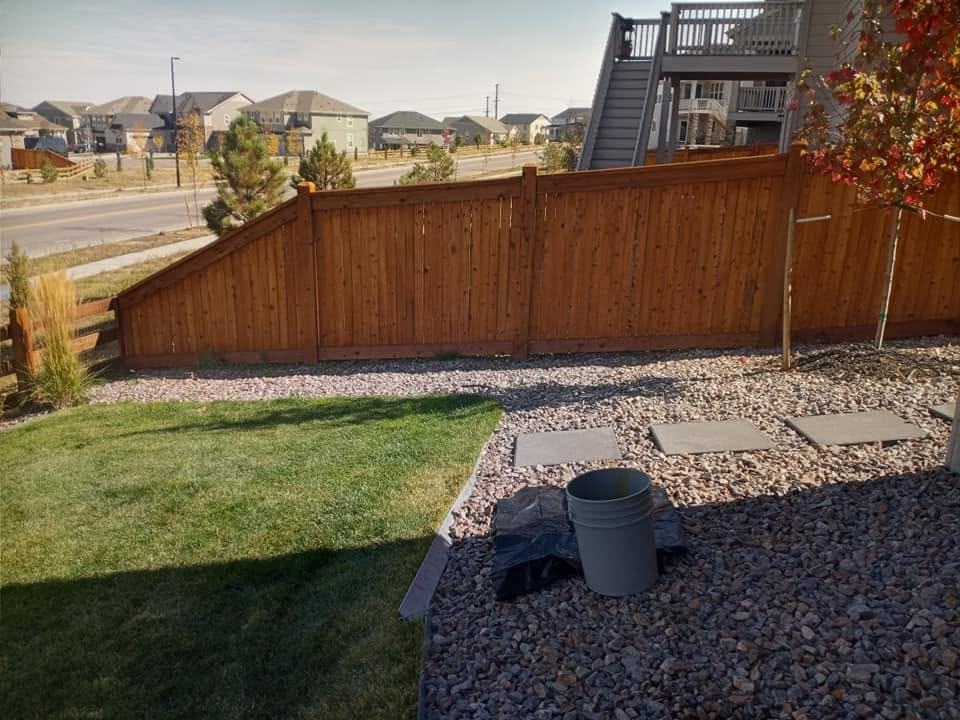
Short answer: not with Blu Bear Stone. This is Colorado. Almost every yard along the Front Range has some slope, from foothill lots to newer subdivisions graded for drainage. We live here too. We expect it, we plan for it, and we don't charge you extra because you chose to live in this beautiful state and be our neighbor.
A slope does change how a fence is built, though, and it's worth knowing what a good crew does differently.
What "percent grade" means
Grade is how much the ground rises or drops over a distance. A 10% grade drops 10 feet over 100 feet, or about 10 inches over one 8 ft fence section. A 5% grade is barely noticeable when you walk it. A 15% grade is a hill you feel in your legs.
How the build changes
| Slope along the fence line | What it looks like | How we build it |
|---|---|---|
| Under 5% grade | Flat or gently rolling | Pre-built panels drop right in between the posts |
| 5% to 15% grade | Drops about 5 to 14 inches per 8 ft section | Each panel stepped down and cut at the bottom to fit the ground |
| Over 15% grade | A real hill, more than 14 inches per section | No panels. Rails follow the hill and the fence is built one picket at a time |
Same price on all three. The extra cutting and fitting is part of doing the job right.
Why some companies charge more for slopes
A sloped fence is more work: every section is measured and cut by hand, posts on the low side of a step are longer, angled cuts leave more scrap, and gaps under the fence get filled so pets can't slip out. Some fence companies pass that on as a slope surcharge. We'd rather give you one honest price, so it's already part of how we quote.
Stepped or racked?
A stepped fence keeps each section level and drops like a staircase. A racked fence angles the rails so the fence follows the ground. Racked usually suits gentle, even slopes and leaves smaller gaps for pets. Stepped suits uneven slopes and is how vinyl panels are usually installed. Cody will show you how both would look on your line.
What to watch for on a hill
- Gaps under the fence. A stepped fence leaves triangle-shaped gaps on the low end of each step. Ask how they'll be closed: a rot board, boards cut to the ground, or buried wire mesh.
- Post depth. Soil and water move downhill, so posts on a slope need good depth. See fence posts in clay and rock.
- Height limits. Cities measure fence height from the ground, so some sections may need to step down. See how tall can my fence be?
Check your slope in the calculator
The fence cost calculator reads USGS elevation along the fence line you draw on the map and shows the grade, so Cody can plan stepped or racked sections before he visits. It doesn't add anything to your price.
Ask for a free estimate and Cody will walk the line with you.